Hyper Creator carries a short-video idea from someone else's playlist to your own audio file
A content hub for TikTok and Douyin. Pull a creator's playlist, lift the transcript from every video, translate it, summarize or rewrite it into your own script, and generate the voice track. One chain across two markets.
The best short-video ideas were in a language half my feed could not read
Short video moves faster in Chinese than in English. A format that works on Douyin shows up on TikTok months later, so the creators worth studying were often the ones I could not skim.
So I watched the back catalog, worked out what each video said, and rewrote the useful part. Each of those steps needed its own tool, and the handoffs between them are where the work died: download here, transcribe there, translate somewhere else, paste into a doc, lose the thread.
Usually on Douyin, usually months before anything like it reaches an English feed.
a screenshotA separate site, an ad wall, and a file that lands in a folder under a numeric name you will not recognize tomorrow.
one at a timeAnother tool, another upload, another export, with no link back to the video it came from.
per videoPaste into a doc, lose the timing, lose the hook structure, keep the gist.
context lostThe script exists and the voice does not, so the idea waits on a session that gets scheduled next week.
the thread diesDownloader sites, a transcription tool, and a translator tab
The chain already existed as four separate products. Assembling it by hand killed the research.
The file, for free, from any public post.
Ad walls, batch limits, and filenames that lose which creator the video came from before you have finished saving it.
RejectedAn accurate script, and accuracy is the part that matters here.
Every upload is manual, the output carries no link back to the post it came from, and per-minute pricing turns scanning a whole catalog into a decision.
RejectedDashboards of views, engagement and follower growth, with trend charts on top.
They report how a video performed and withhold what it said. The script is the part worth studying, and entry pricing runs to tens of dollars a month.
RejectedEach product owns one link of the chain and none owns the handoff. Source, transcript, translation and script stay attached.
One hub that carries an idea from someone else's video to your own file
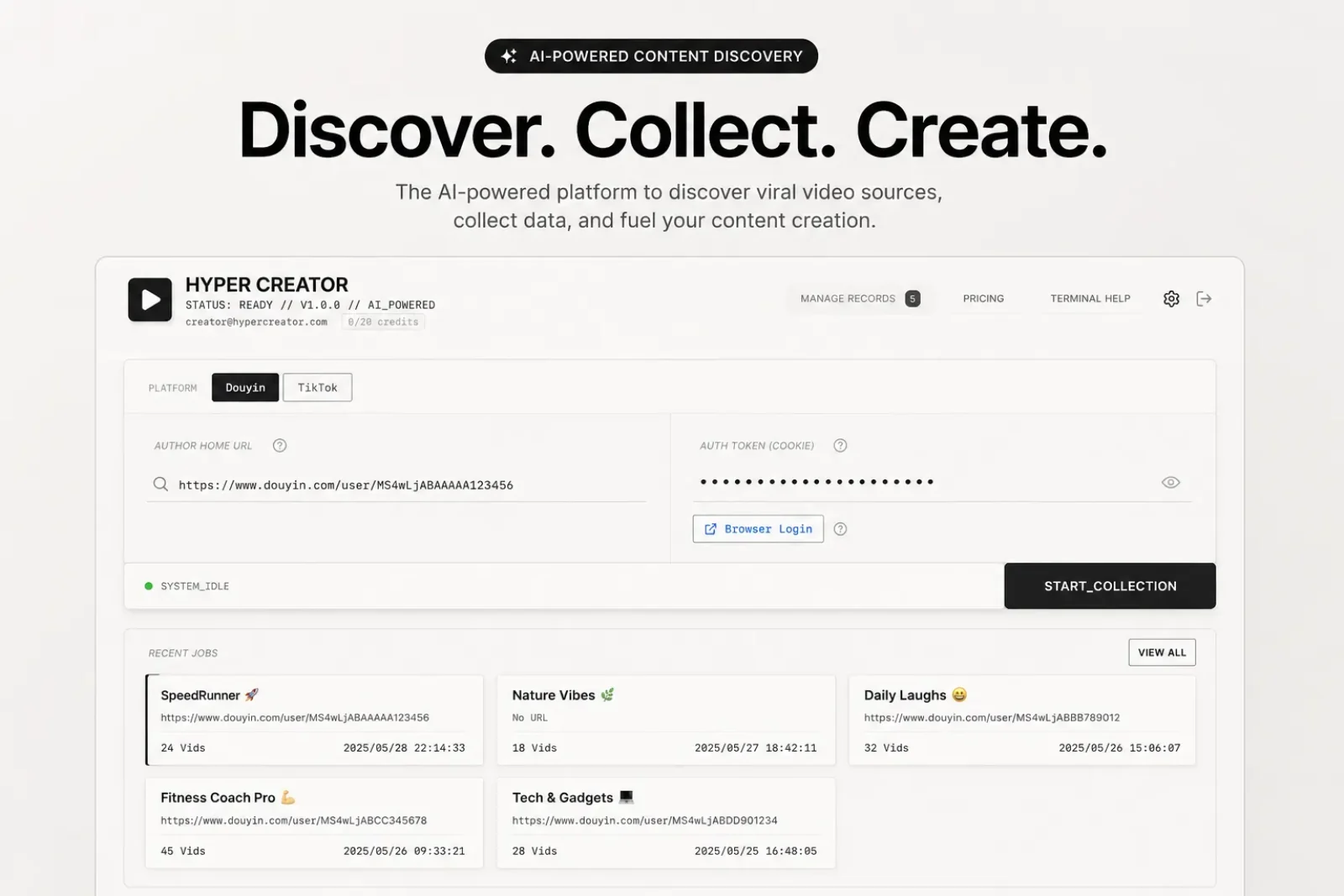
Point it at a creator's playlist and it pulls the catalog, lifts the transcript out of each video, and keeps the set together as a library.
From there the transcript is working material. Translate it, summarize it, or rewrite it into your own script in your own voice. Text-to-speech is built in, so an approved script leaves as an MP3 ready for the edit.
Keep it in one place and the chain never breaks. The idea, its source, the translation and the version you shipped stay attached to each other.
Playlist in, finished audio out
A creator's playlist on TikTok or Douyin becomes a tracked catalog.
You get the script off every video.
Cross-language by default, so a Douyin format is readable months before it reaches an English feed.
Summarize for the pattern, or rewrite into your own script.
Text-to-speech turns the approved script into an MP3, so you have the file that day.
Gemini 2.5 Flash transcribes the downloaded audio, so scanning a whole catalog stays cheap. AI Polish sits on top as a prompt you write yourself, so you translate a Douyin script and adapt its tone in one step. Everything exports to Excel or TXT, because the destination is usually a brief, a content calendar or a client report.
Whose session it runs on, and what the database is allowed to keep
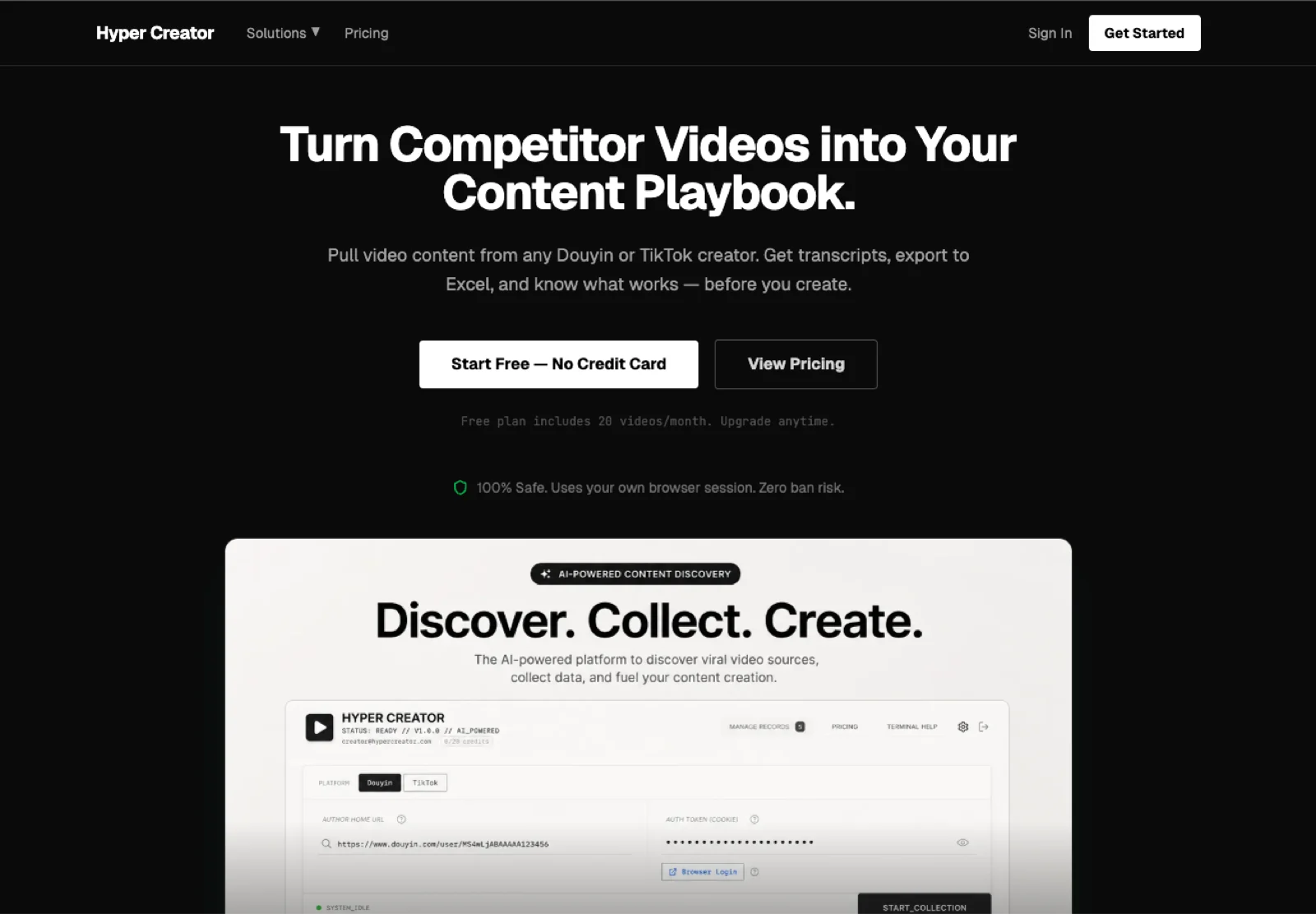
Every tool in this category has the same two problems. The first is whose account does the collecting. Shared account pools are how these tools get their users banned, so this one runs on the user's own browser session and says so on the landing page.
Then I decided what to store. I store post metadata, source links, transcripts, polished scripts, job status and export-ready text. I keep source video and generated audio out. The tool re-downloads from the source link when you ask, and never writes session values to job history.
Pricing follows the same logic. A free tier at 20 videos a month is enough to study one niche, Lite at nine dollars adds AI Polish, and the top tier adds the TTS voiceover. Each tier buys an export rather than a dashboard.
A content hub that works across two markets at once
Ideas stopped being screenshots in a folder. A format spotted on Douyin can be read, understood, adapted and voiced without leaving the tool.
It started as tooling for my own content and ended up packaged as a product. That is the pattern behind most on this page: build it because the manual version is intolerable. Free, Lite and Pro run through Stripe with a credit meter, and mine is still the only account on it.
Research and production are two different tools
TikTok Miner answers questions about a catalog: it embeds everything into a store you can interrogate, which is the right shape when you want to know what a creator does and why it works.
Hyper Creator is the other half. It assumes you know what to make, then carries one idea through translating, rewriting and voicing. They overlap where both need the transcript first: Miner turns it into a store you can question, Hyper Creator carries it to a script and an MP3. The same pairing shows up elsewhere in this set: AdRadar reads the market, CreativeOS writes the response.
A collection layer, a transcription layer, and a hard line about what gets stored
Two decisions shaped the stack: run on the user’s own session, keep source video out of the database. Both cost convenience and both keep the product defensible. The product decisions and the prompts are mine. An AI coding agent wrote the code, and I read every diff before it shipped.
Application
 ReactThe project workspace and transcript library.
 TypeScriptAcross the app and the job pipeline.
 ViteBuild tooling.
 TailwindThe design layer.
 ExpressThe job API behind the collection runs.
Collection
 PlaywrightDrives the user’s own browser session. No shared account pool.
 FFmpegPulls the audio track out before anything is transcribed.
Models
 Gemini 2.5 FlashTranscription off the extracted audio, plus the AI Polish rewrite and translation passes.
Data and delivery
 Neon PostgresJob status, transcripts and polished scripts. Source video files stay out of it.
Drizzle ORMSchema and queries.
XLSX exportThe format a finished catalog leaves in.
Neon PostgresJob status, transcripts and polished scripts. Source video files stay out of it.
Drizzle ORMSchema and queries.
XLSX exportThe format a finished catalog leaves in.
 ResendJob-complete notifications.
 StripeFree, Lite and Pro tiers with a credit meter.
 VercelHosting.
Want this kind of tooling on your team?
A Douyin format read, rewritten and voiced as your own English audio.