CreativeOS writes the ad with the rulebooks already open
It writes ads for regulated categories, where one headline has to clear platform policy, brand and legal rules, and financial compliance. The rules are structured data the generator reads while it writes, and the same records score the audit afterwards.
In payments, every headline clears three separate rulebooks
At PingPong, a B2B cross-border payments platform, writing the ads was the slowest part. I ran the paid channels there, with LinkedIn and Google as the main two, and every line that went live was one I had sent into the three review queues myself. Research tells you what the market is doing. AdRadar reads competitor campaigns and TechSpy reads their infrastructure. Neither one writes your ads.
A single line of ad copy has to satisfy the platform's advertising policy, the company's own brand and legal rules, and financial compliance on top. Three reviewers, three queues, and a rewrite that sends the draft back to the start of all three.
A draft could be produced in twenty minutes and still spend the rest of the week moving between three reviewers who each had a different rulebook open.
You rewrite the same product, audience and proof point from scratch into four platform formats, each with its own character limits.
per platform, by handGoogle, Meta, LinkedIn and Bing each maintain their own rulebook and revise it on their own schedule.
queue 1The firm's own voice rules, competitor-mention rules, disclaimer requirements and discount limits.
queue 2The third reviewer. A change requested by one of the three sends the draft back to the front of all three.
back to step 01AI writers, platform review, a banned-words spreadsheet
At PingPong I worked through the tools already on the team's license list. Each one solved a part of this and left the expensive part alone. I used them at the time, and the verdicts here are written looking back.
Volume and speed, at a fidelity that is good for most categories.
In regulated payments the drafts I sent in came back from the reviewers needing work, so the writing got faster and the queue did not move.
RejectedCopy produced inside a system the team already paid for, with no new tool to adopt.
The same fidelity problem, plus no awareness of per-platform character limits or of the firm's own legal and brand rules.
RejectedThe accumulated knowledge, written by the people who understood the rules.
We applied it from memory and checked it after the writing, and it went out of date the week a platform revised its policy.
Became the schemaThe spreadsheet was the useful one, and its problem was its format. Turning it into structured records the generator could read while writing is the whole build.
Move the rulebooks in front of the writing
Review is expensive because it happens last. If the constraints are available while the copy is being written, most of what review used to catch never gets drafted.
So the policies became data instead of documents. Platform rules, company rules and compliance rules each live as structured records the generator reads, and the same records are what the audit pass scores against afterwards. One set of records does both jobs.
CreativeOS joins two earlier builds: the compliance reading from FinGuard and the platform-policy checking from AdGuard, now sitting inside the tool that does the writing.
It reads the context first, writes angles before copy, and keeps the rules open throughout
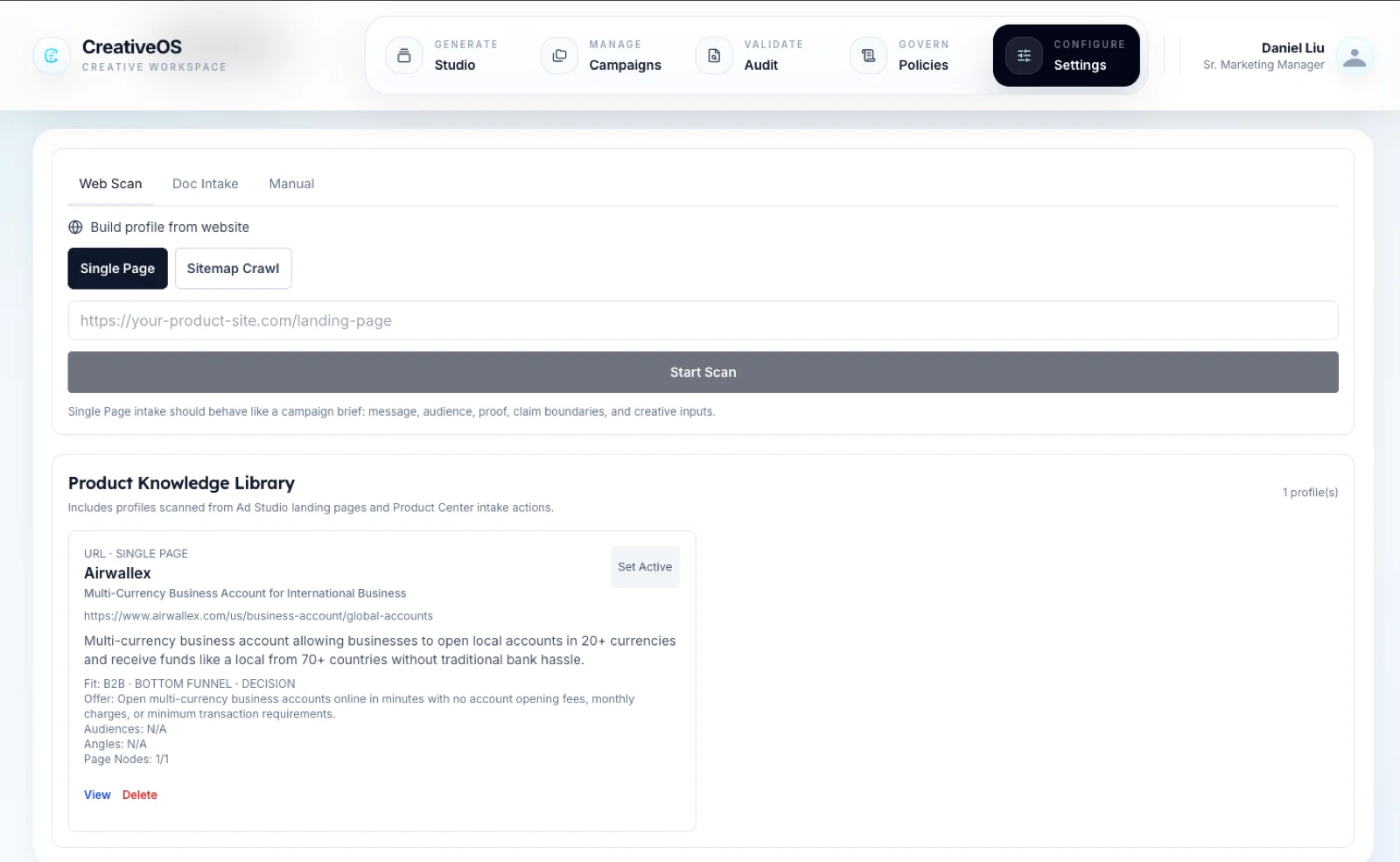
It scans your landing page and builds the product profile: what it offers, the funnel position, the audience and the claims the page already makes.
It writes the angles first, for the platform and format you picked, so the variants argue different things rather than reword one idea.
Each angle becomes copy that fits that placement's spec, down to the headline and body character counts. The specs sit alongside the rules in the same knowledge base.
It scores every line against platform, company and compliance rules, with the rule ID that fired attached to the finding.
Two models with different jobs split the work, one writing and one auditing. The system prompts and the tools each agent may reach live in one layer, so changing behavior is a governed change instead of an edit inside a prompt string.
I built it so compliance edits the policy and the generator obeys it the same day
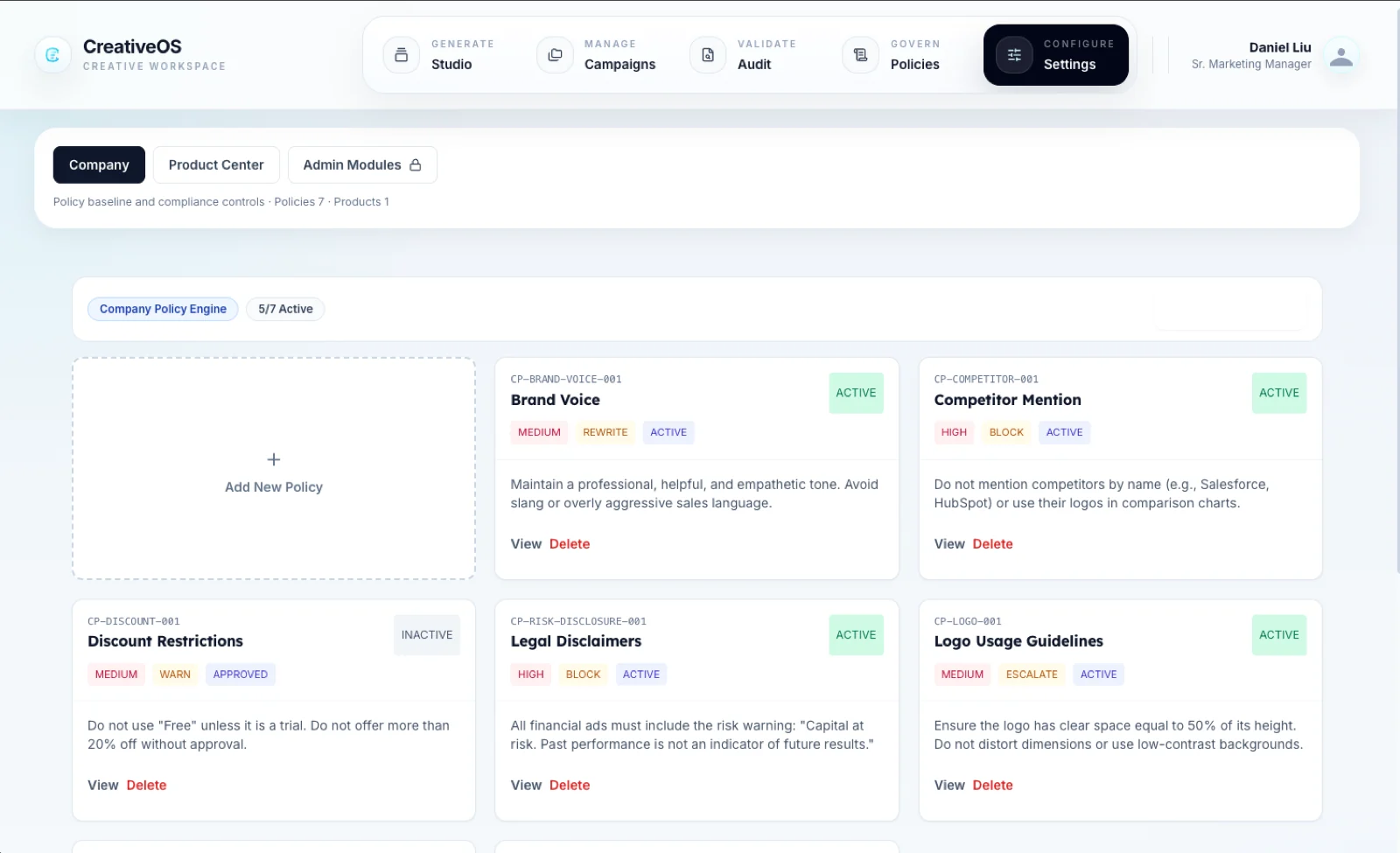
The people accountable for the rules maintain them directly. A compliance officer or marketing manager writes a company policy in the product, sets its severity, and says what happens when copy trips it, whether that is a rewrite, a warning, an escalation or a block. Legal reads the same records.
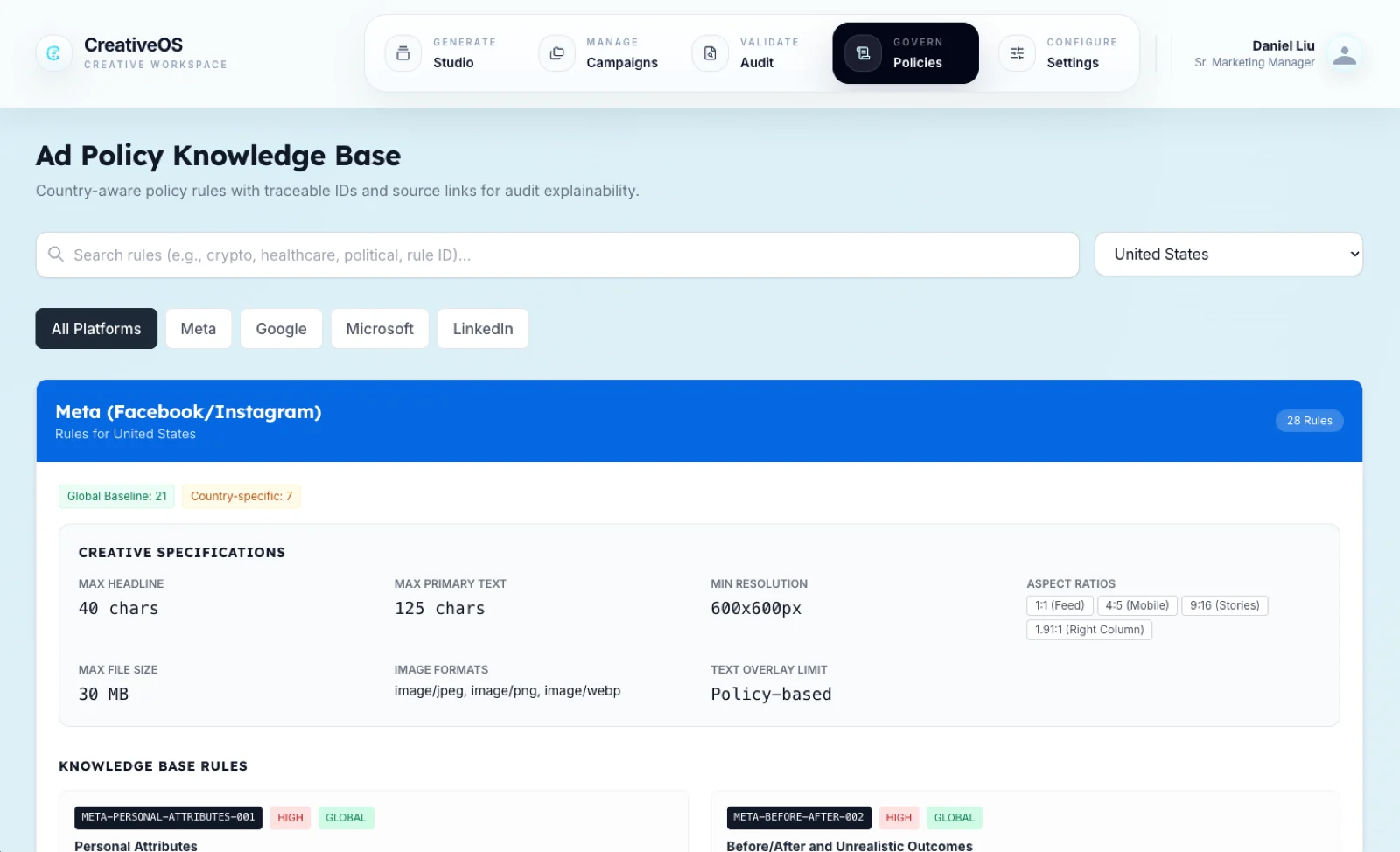
The platform side is a country-aware knowledge base. Rules carry traceable IDs and source links, split into a global baseline and country-specific additions, alongside each placement's creative specification. When a finding appears, it says which rule and points at where that rule came from.
A person still signs off at the end. They should get drafts that already respect the rules, so that sign-off stays a decision.
Compliance owns one screen, and the generator reads it while it writes
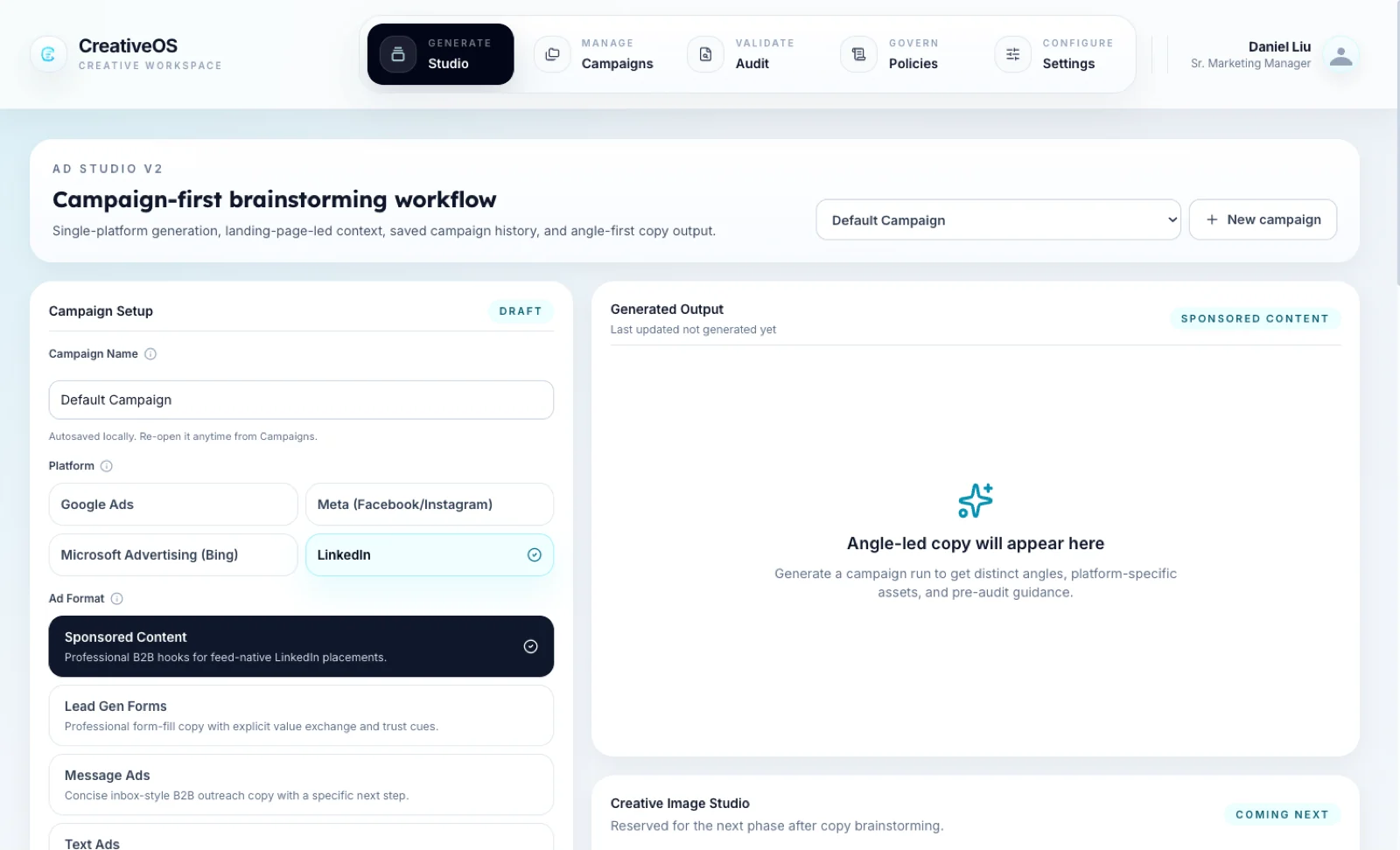
Pick the platform and ad format. It hands back angles, then copy.
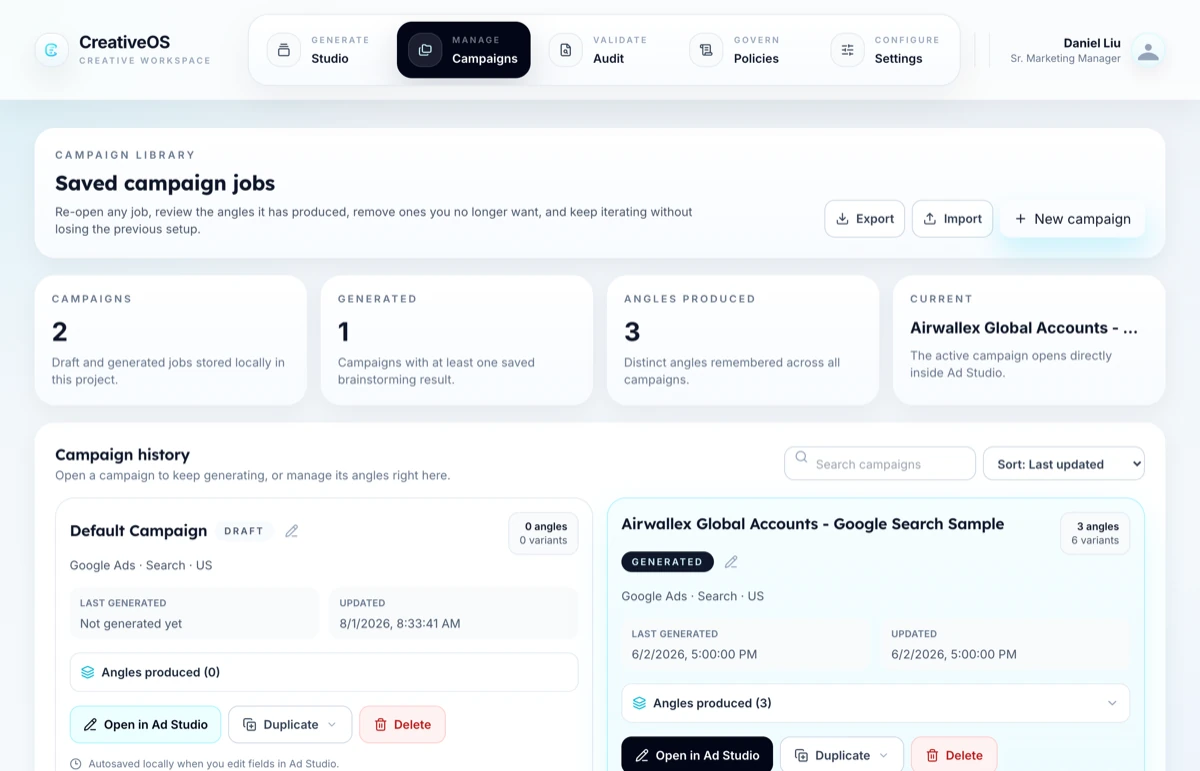
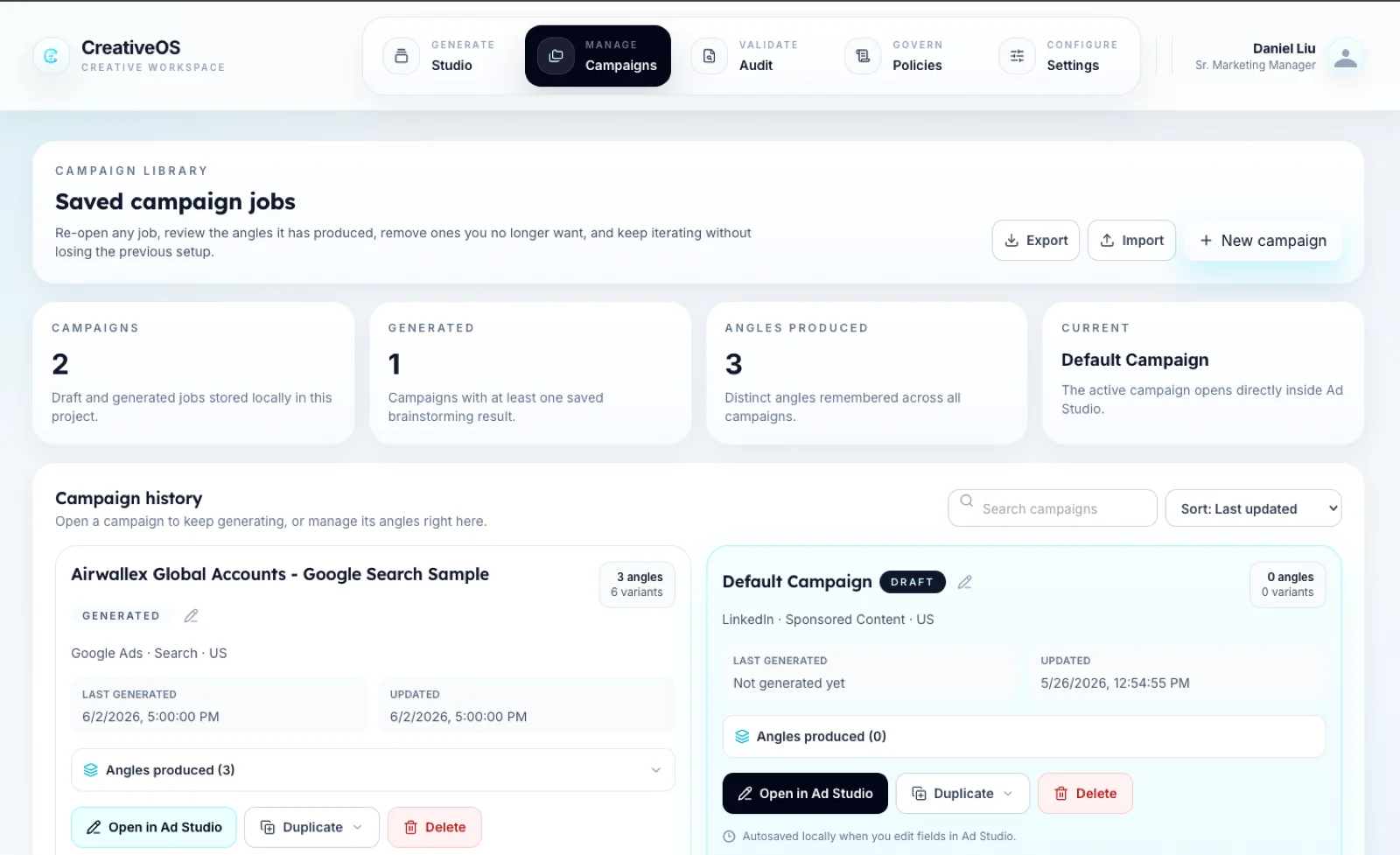
A saved job keeps its angles, so you reopen a campaign and carry on.
It checks the copy and names the rule behind each finding.
It holds the company policy engine and the country-aware platform knowledge base.
It scans the pages the ads point at and keeps what it learns.
Four things a chat window leaves you to do by hand
Any model will write you an ad. The work that eats the afternoon happens after that draft exists, and all four are mechanical enough for the tool to do.
It reads your pages to learn the tone before it writes a line, so the draft arrives in the company's voice instead of a house style you then have to edit out.
It stores the angles on the campaign. Ask for more and it pushes into territory the campaign has not used, which is the difference between testing and repeating.
It counts every field for every platform, spaces included. A 27 of 30 headline is a headline you can paste; a 34-character one is a rewrite you find out about in the ads manager.
Platform and company policy shape the line while it writes, with the reason attached, so the compliance pass stops being a separate round trip.
It covers four platforms and their formats: Google (Search, PMax, Demand Gen), Meta (Feed, Stories, Reels, Carousel), LinkedIn (sponsored content, lead gen) and Bing (Search, Audience, Shopping). The company's own brand, legal and compliance rules run over all four. You can also paste existing copy in and check it against the same rules.
One thing the product refuses to claim: it does not guarantee platform approval, because no tool can. It lowers avoidable risk, and where a line is a judgment call it says so and asks for a human. It is for the marketing and growth people who have to get every line through review.
What runs today, and what I hold back from claiming
The demo is public and opens without a signup. What follows is the part of the build that works today, and the part that is still waiting on evidence from someone other than me.
Running
All five surfaces work: Studio, Campaigns, Audit, Policies and Settings. Three layers of rules sit underneath them, platform, company and compliance, and the audit path runs in both directions, so the same rules score the copy it writes and the copy you paste in.
Not claimed
I am the only person who has run it. The workflow where compliance owns the rules and the generator reads them the same day is a design decision I made, and it stays a design decision until a team outside me puts drafts through it.
Related
Two models with different jobs, and the rulebooks as data underneath both
The rulebooks live as records, so one source writes the copy and then scores the audit. One source, used twice.
Application
 ReactThe five-surface workspace.
 TypeScriptIncluding the policy-rule types, so a malformed rule fails at build.
 ViteBuild tooling.
 TailwindThe design layer.
Models
 Gemini 2.5 FlashWrites the angles and the per-platform copy, where speed beats depth.
 DeepSeekThe policy audit pass, which reads each line against the matched rules and writes the reason.
Knowledge
Policy knowledge basePlatform rules per country, each one traceable to its source, kept as records the generator reads. Company policy engineThe firm’s own rules with a severity and an enforcement action per entry. Product knowledge libraryBuilt by scanning the landing pages the ads point at.Delivery
 VercelHosting and the generation endpoints.
Want this kind of tooling on your team?
The rules sit as records, so you can open the demo and watch all three rulebooks apply while the copy is written.