Scaling SMB Outbound Using a Marketing-Led Revenue Engine

Building a hybrid outbound system powered by marketing infrastructure, data signals, and operational automation

Context & Problem

When I joined the company, the SMB sales team relied almost entirely on traditional outbound: calling lists they sourced manually, emailing prospects one by one, and cycling through spreadsheets in search of the next opportunity.

The process worked, but it didn’t scale. Each sales team pursued their own tactic, their own territory map, and their own version of “ideal prospects.” More importantly, outbound operated as a completely separate universe from marketing, despite the fact that both functions targeted the same prospects at different stages of awareness. There was no shared data, no shared signal, no shared cadence.
Sales team constantly complaints about getting no support from Marketing.


But in my view Marketing had no way to support the process without integrated system and necessary tools. We can't manually download data from internal customer CRM and upload audience to run the campaign. It soon become a rabbit hole. 

Outbound wasn’t just inefficient; it lacked a system for marketer to operate. And without a integrated and connected tech stack, no amount of activity could produce consistent results.

Constraints & Complexity

SMB outbound is uniquely challenging in fintech.

Prospects exist across dozens of verticals; some operate in import/export, some in logistics, and others in entirely unrelated categories but still require cross-border payments. (i.e. translation company, staffing, technical support business)

Eligibility varies by region. Business models vary in complexity.
Contact data is scattered across platforms like ZoomInfo, industry trade shows, niche directories, and import/export databases such as Panjiva. Compounding the challenge, Salesforce and the company’s homegrown product CRM were completely disconnected.


Sales reps could close a lead without marketing ever seeing the lifecycle; marketing could influence awareness without sales ever knowing these signals existed. Both sides were operating blind. This environment required more than improving productivity. It required a hybrid engine. One that merged outbound targeting, marketing signals, nurture, retargeting, and CRM automation into a single structure that could guide the team toward predictable, scalable motion.

Cross-Functional Collaboration

Designing this onboarding automation required aligning multiple teams that historically touched customers at different times. I worked with product and engineering to map customer states and standardize onboarding definitions across database, ensuring that registration, verification, document status, and approval all translated into lifecycle signals the CRM could understand. Compliance teams helped define which categories required manual review and which could move through automated flows. 

Customer Support provided insight into common friction points, which informed the educational content embedded in the email cadences.

Internally, I collaborated with content manager and UX designer to build nurture content tailored to each onboarding stage, while Sales and BD shaped the rules for when a human should intervene and when automated guidance was sufficient. The result was a shared lifecycle model that every team could rely on clearer, faster, and consistent across markets.

The Hybrid Outbound Engine


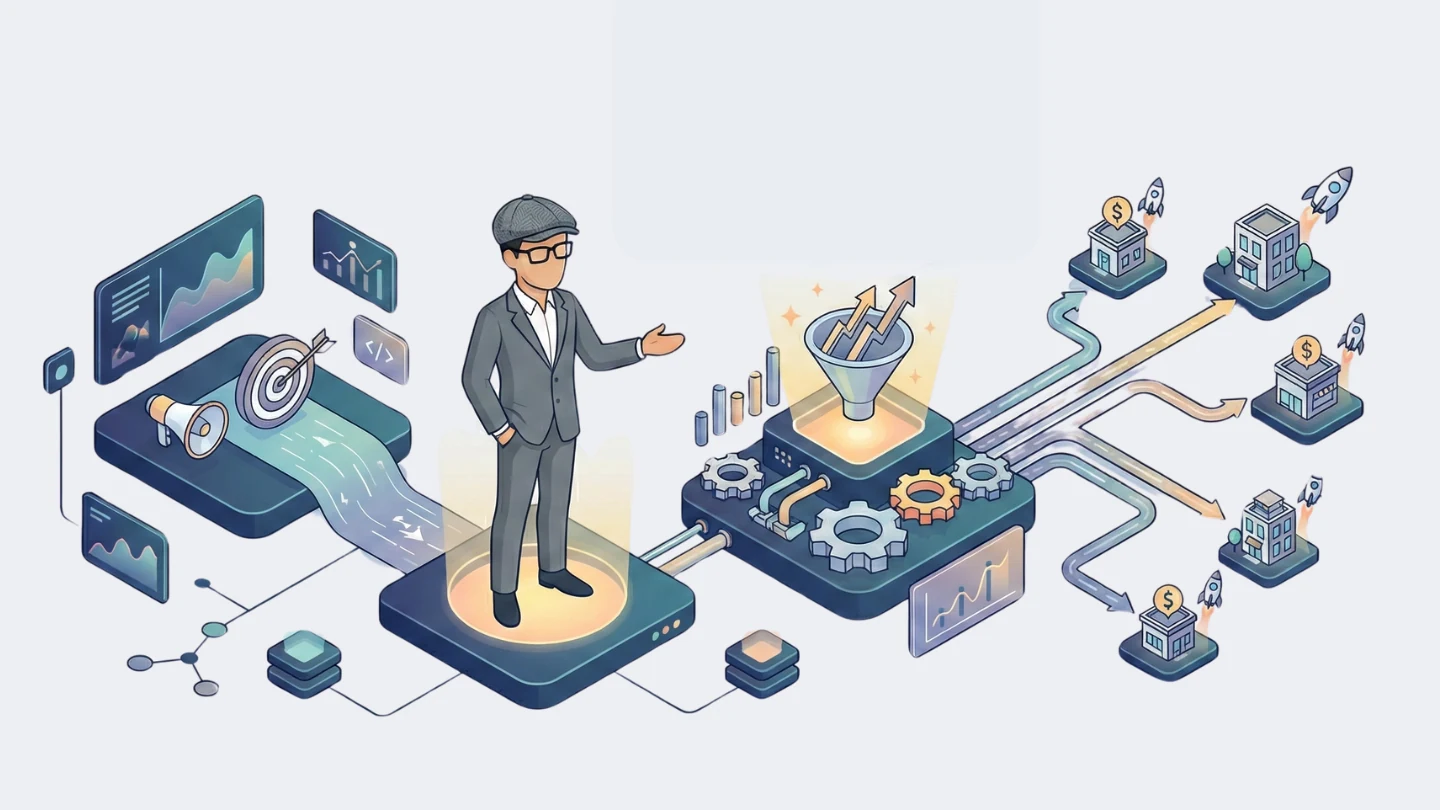
To transform outbound from a manual pursuit to a scalable revenue system, I designed a hybrid automation engine that connected marketing infrastructure with outbound motions at every touchpoint.It began with targeting.

I initially work closely with our Sales Director, we discussed defined niche markets and verticals, mapping out ICP patterns the team previously identified only through anecdotes. Instead of reps sourcing companies individually, we built structured prospect sets inside Salesforce and aligned four pilot reps to test each vertical using Salesloft cadences designed around consistent and custom messaging and follow-up rhythm. This framework turned outbound from an art into a repeatable experiment.

After experiment, each vertical produced clear signals with clean data, conversion behaviors, quality indicators, and we refined our ICP based on real performance instead of intuition. Once the targeting foundation was in place, I finally introduced the marketing layer the team had been missing.

From the moment a company interacted with our website, ZoomInfo automatically identified the visiting organization, mapped their behavior across pages, and triggered weekly intelligence reports sent to sales via Slack and email. Outbound reps no longer worked in the dark; they could see which companies they worked on were warming up, which showed intent, and which required timely outreach. At the same time, retargeting campaigns on Google, LinkedIn, Facebook, and Taboola ensured that cold prospects did not remain cold.

Every site visit, every email interaction became part of a multi-touch awareness program that supported the outbound channel rather than competing with it. For example, for prospects who entered our content ecosystem such as downloading resources or joining email lists, I designed a 30-day nurturing sequence anchored in value-added content and industry-specific insights.
This sequence pre-qualified interest, educated prospects, and softened otherwise cold outreach.


By the time an outbound rep called, the prospect had already seen our brand multiple times and had interacted with content designed to move them from unaware to consideration.The final layer was operational unification.
Through a combination of Zapier, native integrations, and API connections—particularly between Salesforce and the homegrown CRM—I unified lifecycle signals so reps could see account status without asking support or product teams for updates.
This integration eliminated the manual gaps that previously slowed follow-up and allowed outbound and marketing to operate on the same customer journey framework.The result was not a set of tools stitched together, but a hybrid outbound engine that combined ICP experimentation, signal intelligence, marketing automation, and sales execution into one cohesive system.

Impact

  1. The lifecycle automation changed the onboarding experience for both customers and internal teams.
  2. Users moved through KYC/KYB more quickly because they understood what was required at each step, and the customized email and support guided them before friction became abandonment.
  3. Support volume dropped because many repetitive questions were addressed proactively through automated education. Sales and BD gained visibility into exactly where each prospect was in the onboarding process, allowing them to focus on accounts that truly needed human intervention rather than chasing unclear statuses.
  4. Marketing achieved a more controlled, structured nurture process, ensuring that every customer received the right message at the right time not generic drip emails. Activation improved because customers reached verification faster and began using the product sooner.
  5. Internally, the company gained a more predictable onboarding pipeline, clearer data, and a lifecycle system that could scale across new regions and product categories.This was not simply a set of onboarding emails.
  6. It was an operational architecture that connected CRM signals, email trigger logic, educational content, sales coordination, and product usage into a cohesive experience.

Why This Matters

In a fintech environment, onboarding is the moment when marketing, product, compliance, and sales all converge.
If the experience is fragmented, the business loses activation, revenue, and customer trust.


What the onboarding automation accomplished was more than efficiency. It created a coherent customer journey, from the moment someone registers to the moment they begin actively transacting. By turning onboarding states into actionable lifecycle signals, the system made customer progress visible, actionable, and consistent across global teams.

It reduced operational strain, increased activation success, and established a foundation that future products and markets could plug into.Ultimately, the system demonstrated how lifecycle automation can serve as the backbone of a fintech growth engine, bridging human judgment, compliance requirements, and intelligent automation into one unified experience.