When I took over revenue operations for the North America and Europe funnel, lead processing still depended heavily on manual work.
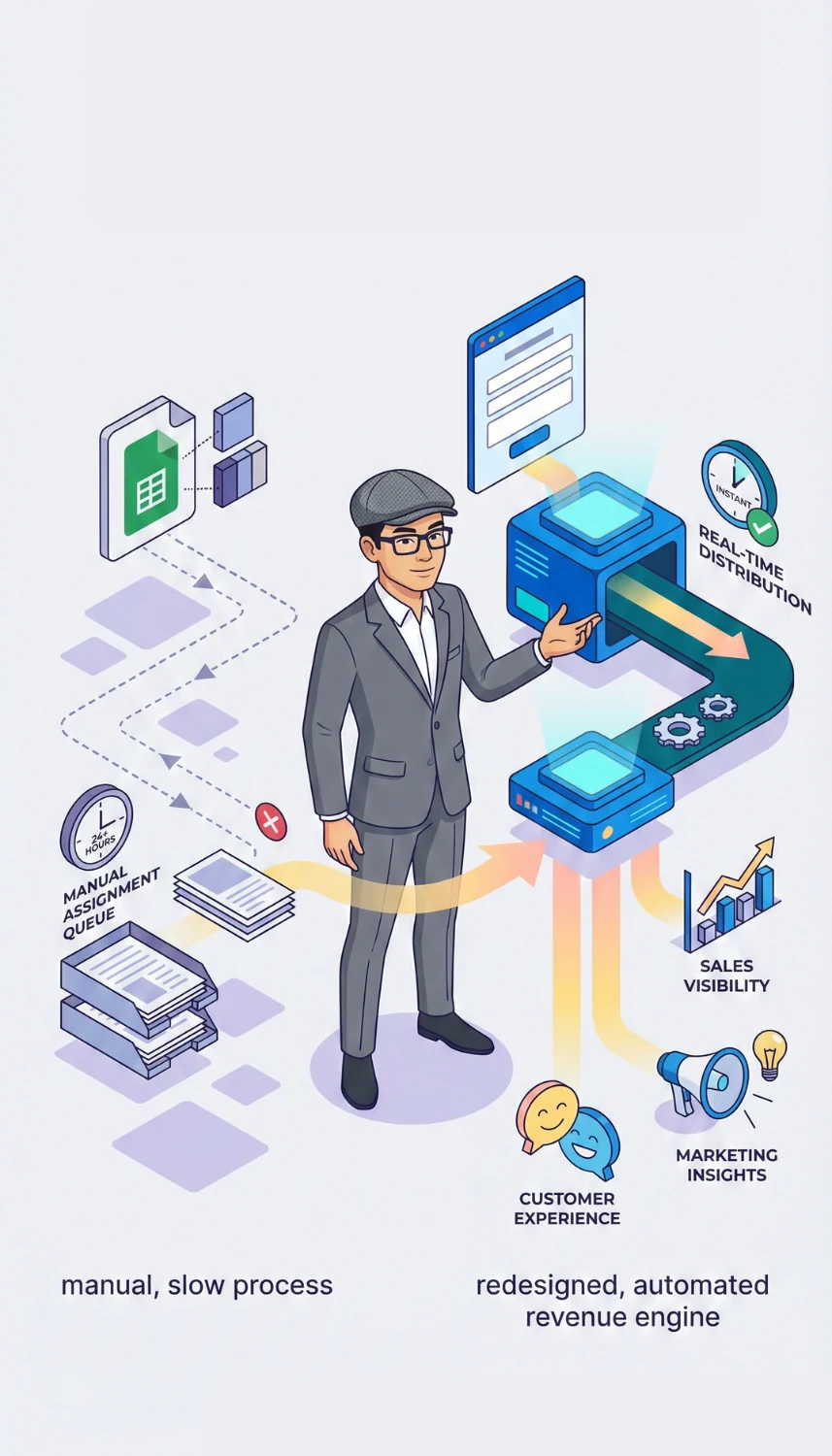
Website leads were exported to spreadsheets, reviewed by sales ops, routed by hand, and only then assigned to BD or sales. The cycle could take up to 24 hours, and even longer during peak volume.
For a global B2B fintech business, that delay meant missed SLAs, slower follow-up, and inconsistent customer experience from the very first touchpoint. The problem was bigger than “we need more automation.” The revenue engine itself needed redesign.
Building a scalable fix meant handling multiple layers of complexity at once.
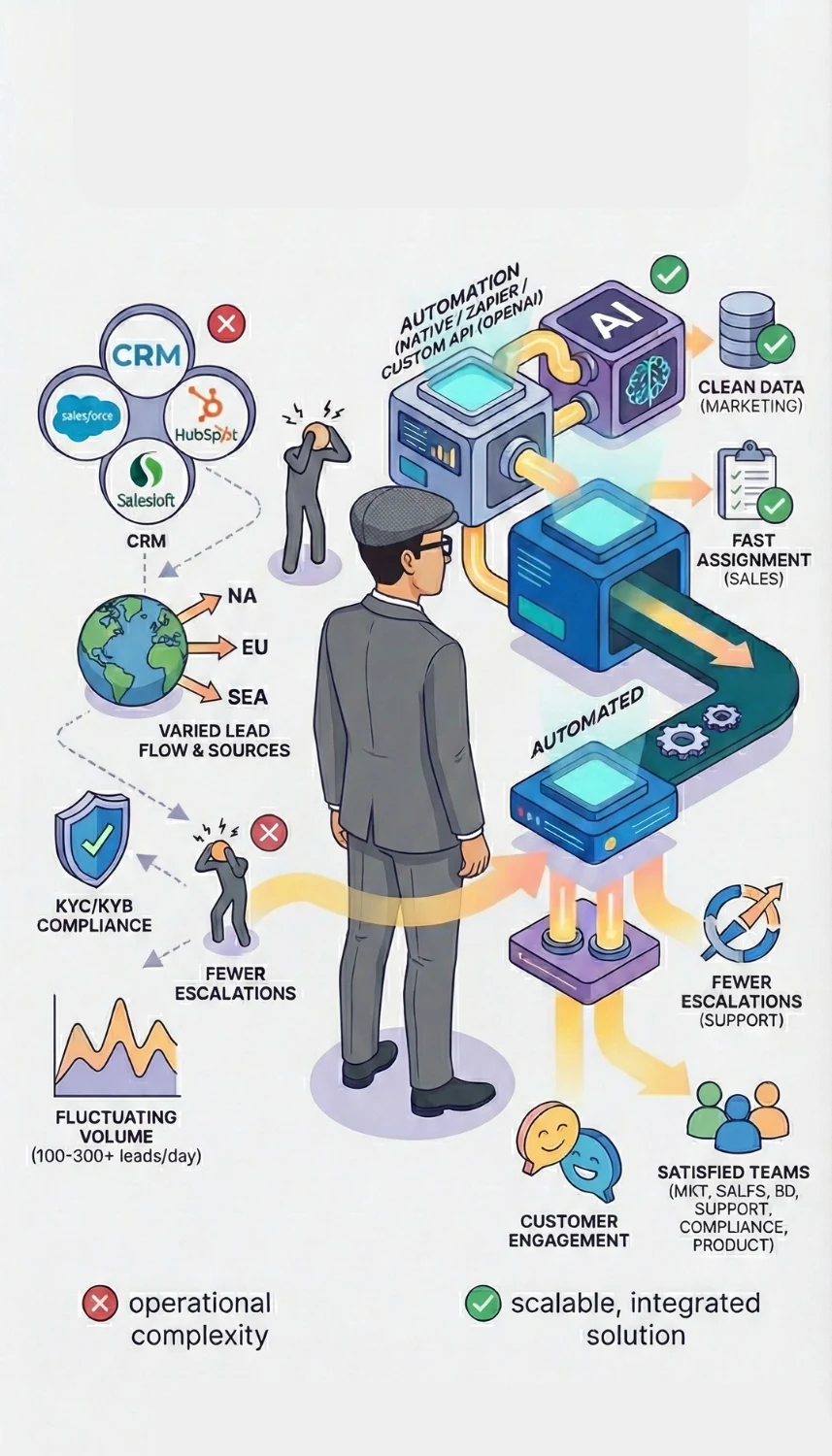
- The process touched Salesforce, HubSpot, Salesloft, internal CRM systems, and API endpoints.
- Lead flow varied by region, source, and segment.
- Fintech onboarding added compliance steps like KYC and KYB.
- Teams in NA, EU, and SEA all had different routing rules, ownership models, and SLAs.
- Volume moved quickly, from roughly 100 to 300+ leads a day.
- Marketing needed cleaner data; sales needed faster assignment; support needed fewer escalations.
- Automation had to stay reliable across native integrations, Zapier, and custom logic.
The constraint was not only technical. It was organizational. The system had to satisfy marketing, sales, BD, support, compliance, and product teams at the same time.
Building the engine meant aligning teams that had historically worked in separate systems.
I worked with sales and BD on routing logic, territories, cadence rules, and prioritization. Product and engineering exposed onboarding and activity data through internal APIs. Compliance helped define exception handling. Support workflows were updated so onboarding friction could trigger faster help. Data and ops teams helped keep lifecycle stages and field mappings clean.
The goal was not just to automate tasks. It was to create a shared operating model the entire revenue organization could trust.
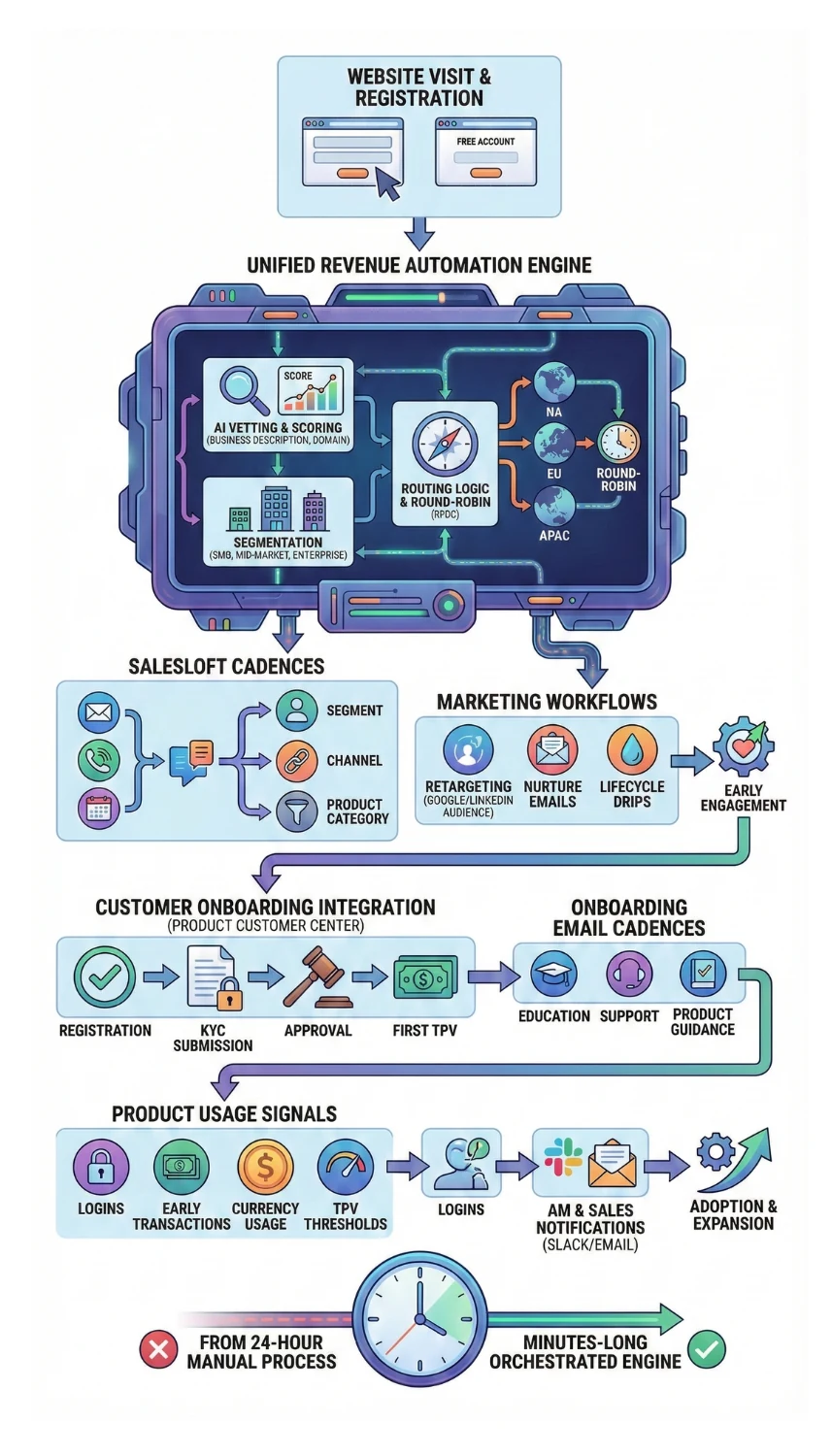
Over four months, I designed a unified revenue automation engine that connected website forms, qualification, routing, outbound, lifecycle nurture, and onboarding signals into one operational system.
When a lead or free-account signup came in, the workflow validated the record, ran AI-assisted vetting, checked completeness, segmented the lead, and routed it to the right regional team within minutes. Salesloft cadences were triggered automatically based on segment, channel, and product.
Marketing workflows ran in parallel: retargeting audiences, nurture emails, and lifecycle drips. Once a prospect became a customer, onboarding states such as registration, KYC submission, approval, and first TPV triggered different education and support flows.
What started as a 24-hour manual process became a minutes-long engine connecting acquisition, qualification, onboarding, and expansion.
The system fundamentally changed how the company processed and converted leads:
The value of this project was not automation for its own sake. It was the shift from a fragmented, manual process to an operating system the revenue team could actually run on.
I built more than 80 automated workflows connecting marketing, sales, support, product, and compliance into a single experience. Because the system was modular, rule-based, and API-aware, it could evolve with new products, regions, cadences, and onboarding steps without needing a full rebuild.
This is the kind of work that compounds: cleaner routing, faster follow-up, better activation, and a revenue organization that spends less time on operational drag.