From HQ-controlled codebase to a scalable Webflow-led platform
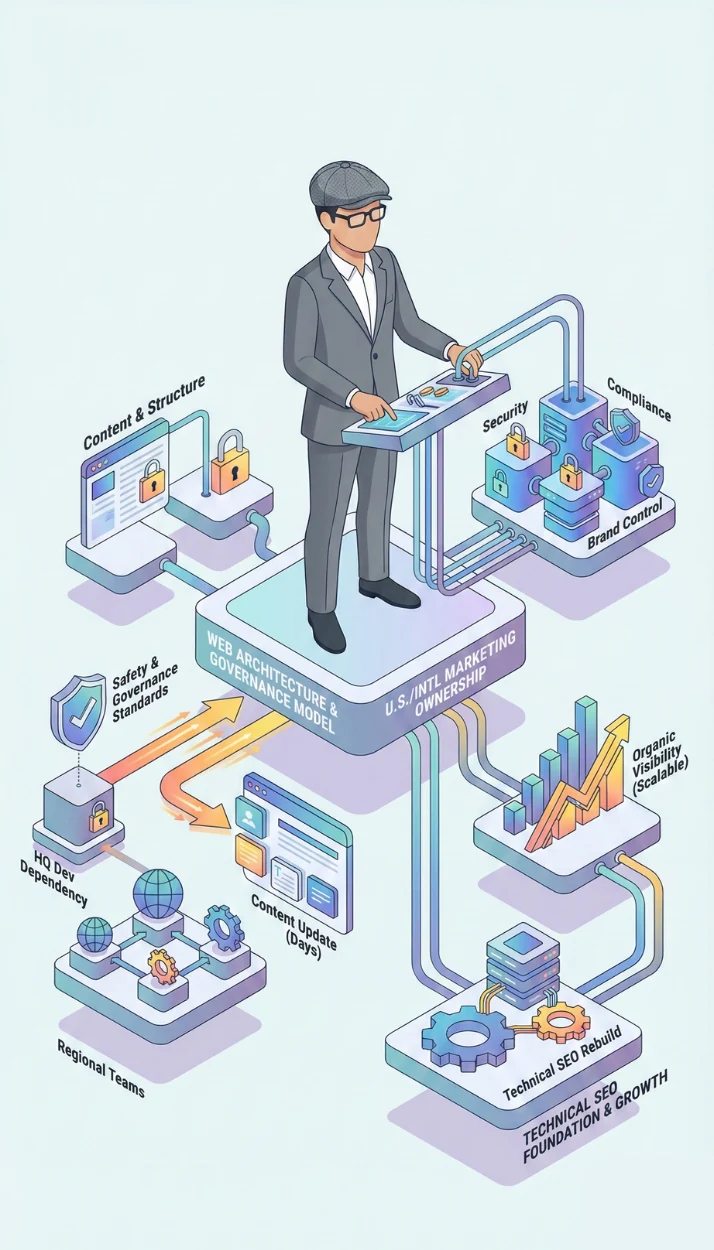
When I joined the company, our North America website lived entirely under headquarters’ control. It was a custom-coded frontend maintained by the central development team, and every change, no matter how small, had to be added to their sprint queue. For the U.S. and international marketing teams, this meant that new landing pages, PR updates, copy changes, and product messaging often took four to five weeks to go live.
The problem wasn’t just delay. The CMS powering the blog was outdated and lived on a separate subdomain, which weakened SEO impact and made content publishing clunky. For a fintech company that needed to communicate quickly with SMBs, partners, and enterprise prospects across multiple regions, the website had become a structural bottleneck. Marketing wanted to move at campaign speed; the web stack was operating on release cycles.
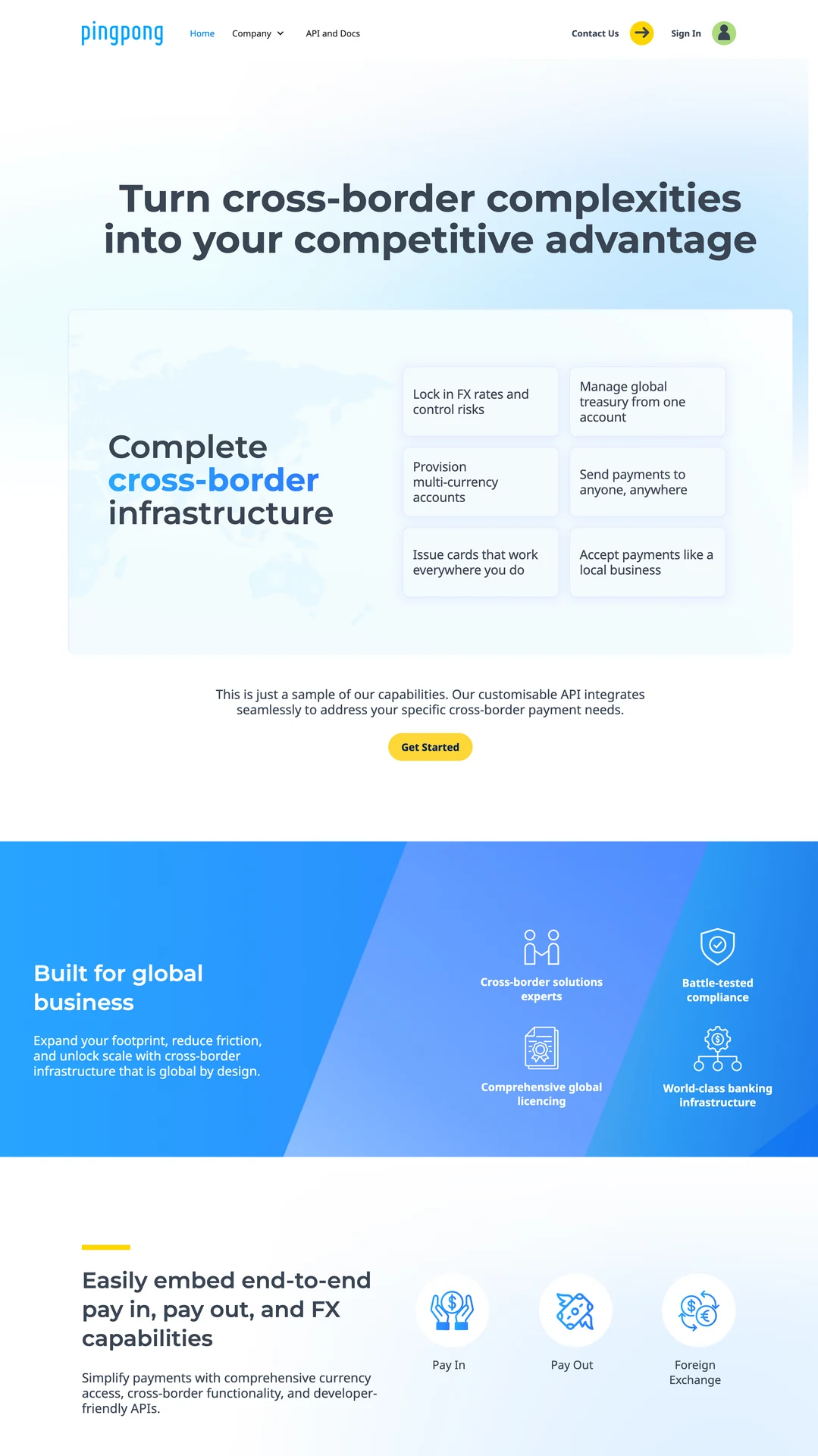
The initial rebuild took roughly three to four months and followed a structured, multi-phase path. I started by redesigning the information architecture for what would become international.pingpongx.com, consolidating previously fragmented regional sites such as usa.pingpongx.com and various UK/EU properties. The goal was to create a single, coherent international site that could represent our capabilities across North America, the UK, and Europe, while still supporting regional nuances.
Working with a U.S.-based UI/UX designer, I defined the site map, page hierarchy, and layout patterns for core sections, including products, solutions, compliance, and resources. We designed a small set of reusable templates—roughly four key page types—that would allow us to scale from the initial batch of 30+ pages to future configurations without recreating layouts from scratch. Ownership was distributed based on expertise: compliance partnered on regulatory pages, product and product marketing helped shape solution and product content, and sales reviewed whether the pages matched how prospects actually researched us.
In parallel, I coordinated with HQ IT on IP-based redirection, DNS changes, and the launch cutover plan. We agreed on a specific migration window, defined which legacy domains and paths would redirect into the new structure, and ensured that both search engines and users would experience a clean transition. By the time we went live, the new infrastructure, redirects, and content model were all aligned and approved, allowing for a relatively smooth switchover despite the number of systems and regions involved.
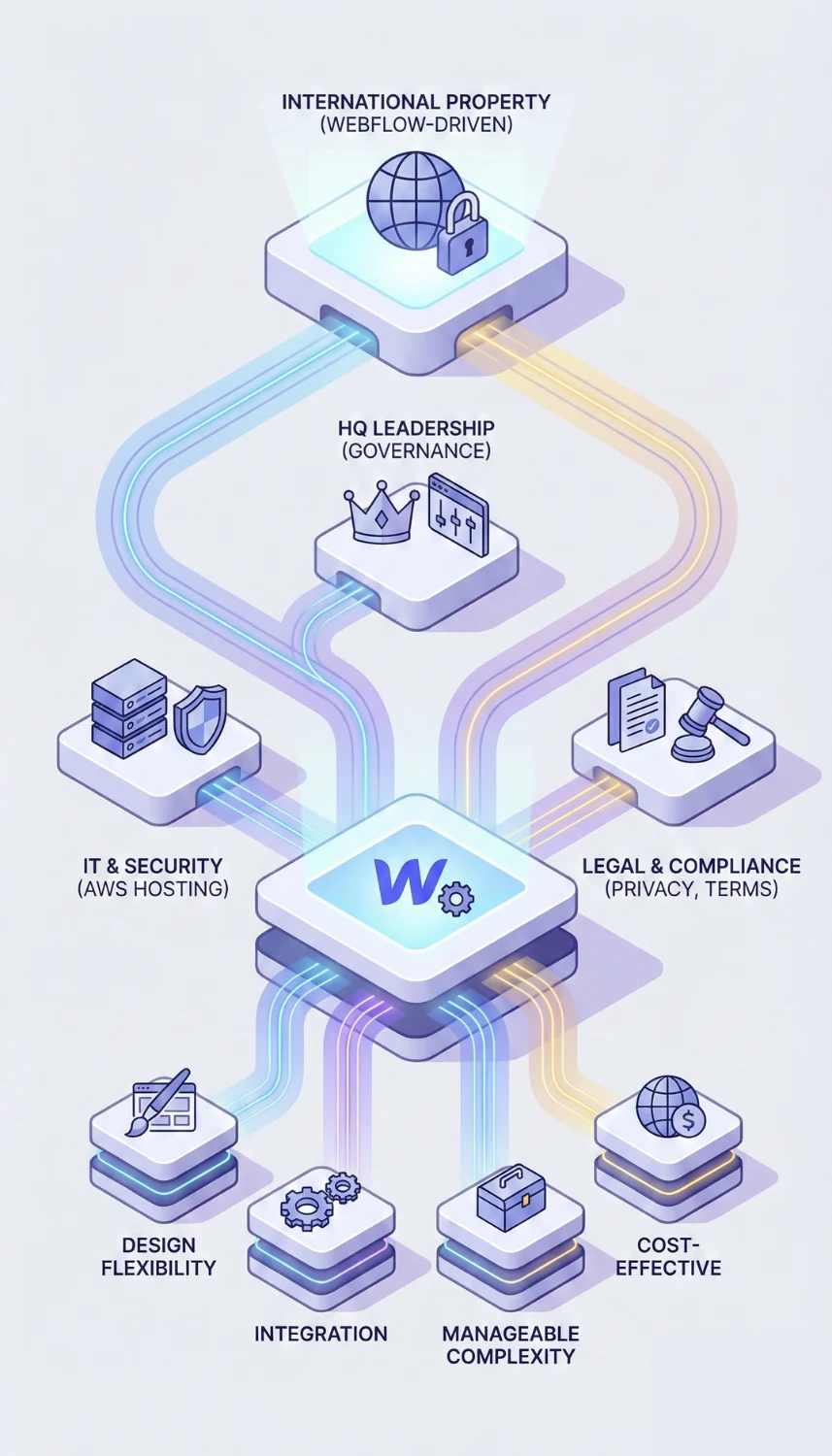
I led the evaluation of low-code and no-code options and ultimately selected Webflow as the core platform. The decision balanced several constraints: it offered enough design and structural flexibility for a modern international site; it integrated cleanly with our existing automation and CRM stack; the complexity level was something I could manage directly; and it was cost-effective for a multi-region marketing property.
Selecting a platform was only the first step. The more important work was aligning stakeholders across IT, legal, compliance, and headquarters leadership. With IT, I walked through Webflow’s infrastructure, security model, and AWS hosting, translating their security documentation into the specific assurances our internal teams needed. With legal and compliance, I ensured that cookie policies, privacy terms, and disclosure language could be implemented exactly to spec. With HQ management, I clarified that they would retain full transparency and control through super-admin access, while the U.S./international team would operate within a defined permission model focused on content and layout, not infrastructure.
This combination—clear boundaries, documented safeguards, and a transparent governance model—was what ultimately moved headquarters from cautious to comfortable. It allowed us to shift from a centrally coded site to a Webflow-driven international property without triggering the usual “this is unsafe” reflex that is common in fintech environments.
Because we were effectively rebuilding the site, I treated this as an opportunity to lay down a durable technical SEO framework. I defined standards for meta titles, descriptions, headings, internal naming conventions, and image alt text across all major templates. Each page type—whether a solution, product, or resource—had a clear keyword focus and a consistent metadata structure. I implemented schema markup to improve indexability and clarity for search engines, and ensured the new international domain was configured in a way that supported, rather than fragmented, organic visibility.
We also replaced the legacy third-party blog subdomain with Webflow’s native CMS, designing separate templates for ongoing blog content and long-form, agency-written articles. This allowed us to keep PR, SMB-focused education, and thought leadership under a single, SEO-friendly structure while making publishing significantly easier for the content team.
The impact was visible on multiple fronts. Operationally, content updates that once took four to five weeks could now be completed in two to three days, including internal review. The marketing team no longer needed to negotiate for sprint space with HQ developers for routine website work. Strategically, the combination of stronger technical foundations, clear SEO governance, and more frequent, relevant content led to a noticeable improvement in organic performance: growth shifted from marginal, low double-digit increases to a much stronger, sustained trajectory driven by structure rather than ad-hoc fixes. Equally important, we were able to retire our dependency on external technical SEO vendors and manage the web channel as an internal capability.
After launch, I acted as the long-term site owner for roughly eighteen months, responsible for stability, iteration, and integrating new automation workflows as our stack evolved. The initial migration was the most complex phase; subsequent redesigns and UI/UX refreshes were significantly smoother, which validated the robustness of the new architecture. Over time, different members of the team took on ownership for their respective areas—content managers could schedule and update pages directly, compliance could request and receive faster updates to regulatory content, and sales had a site they were confident sharing with prospects.
The response from internal stakeholders reflected the shift. Sales described the new site as more credible and visually aligned with the expectations of their customers. Compliance appreciated having a consolidated, global compliance structure that could be updated through a clear, predictable process. Regional teams in Southeast Asia adopted many of the templates and patterns we developed, effectively cloning the model for their own markets and proving its scalability beyond the original scope.