Build AI Vetting & Intelligent Routing Automation

Context & Problem

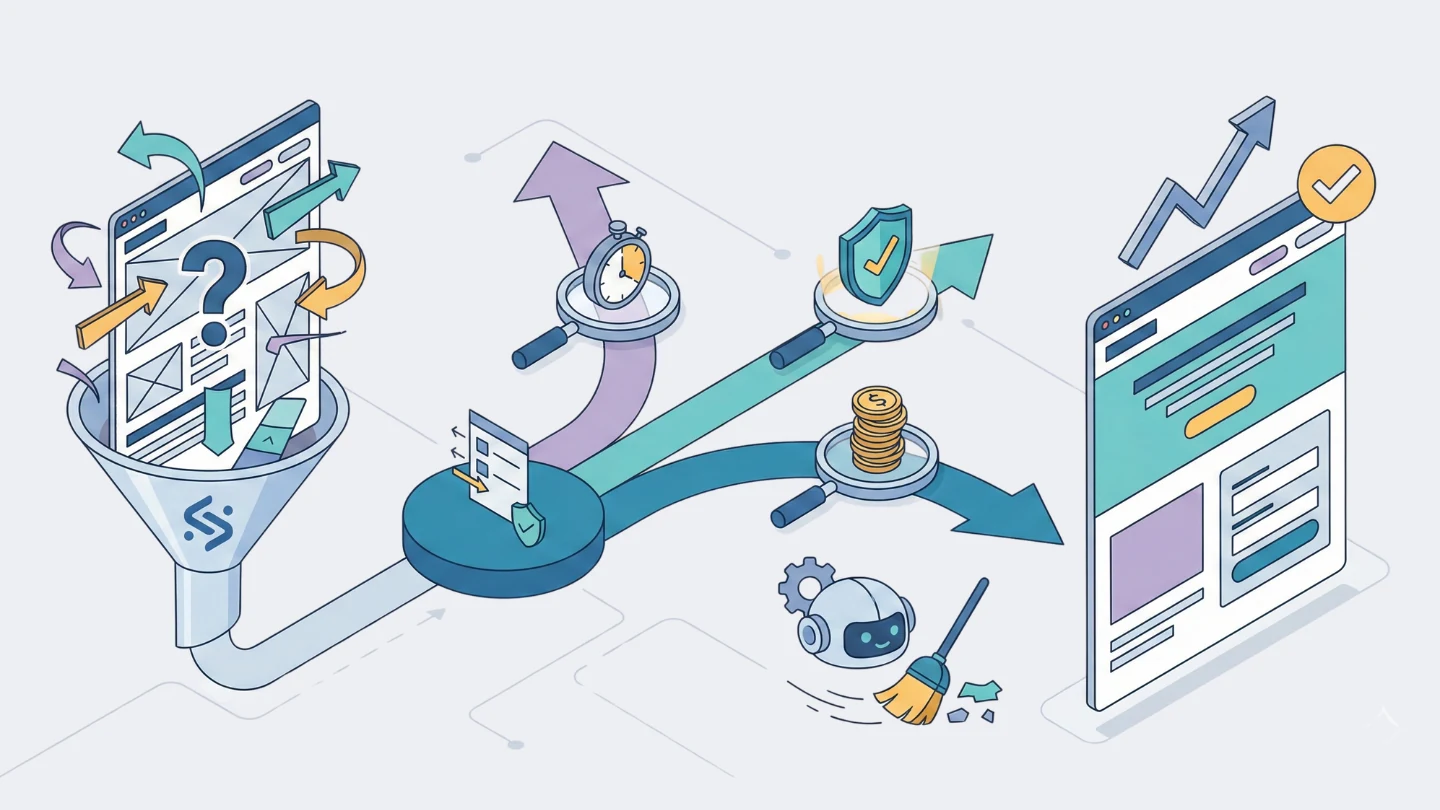
Before AI was added into my automated revenue workflow, our lead qualification (MQL -> SQL) depended almost entirely on manual judgment.

BD teams were spending valuable time checking domains, researching companies, interpreting ambiguous business descriptions, and deciding whether a lead belonged to their territory or should be escalated elsewhere.

This created slow, inconsistent, and error-prone decision-making. Leads arrived at different stages of completeness; some required additional review, others were high-value but received late follow-up simply because no one had time to research them fast enough. The problem was not just slow qualification, it was a lack of structure behind how qualification happened.

Pipeline momentum suffered as a result. and disconnected Marketing and Sales technology makes my work very hard.

Constraints & Complexity

Designing an automated routing system meant reconciling a high level of operational complexity.

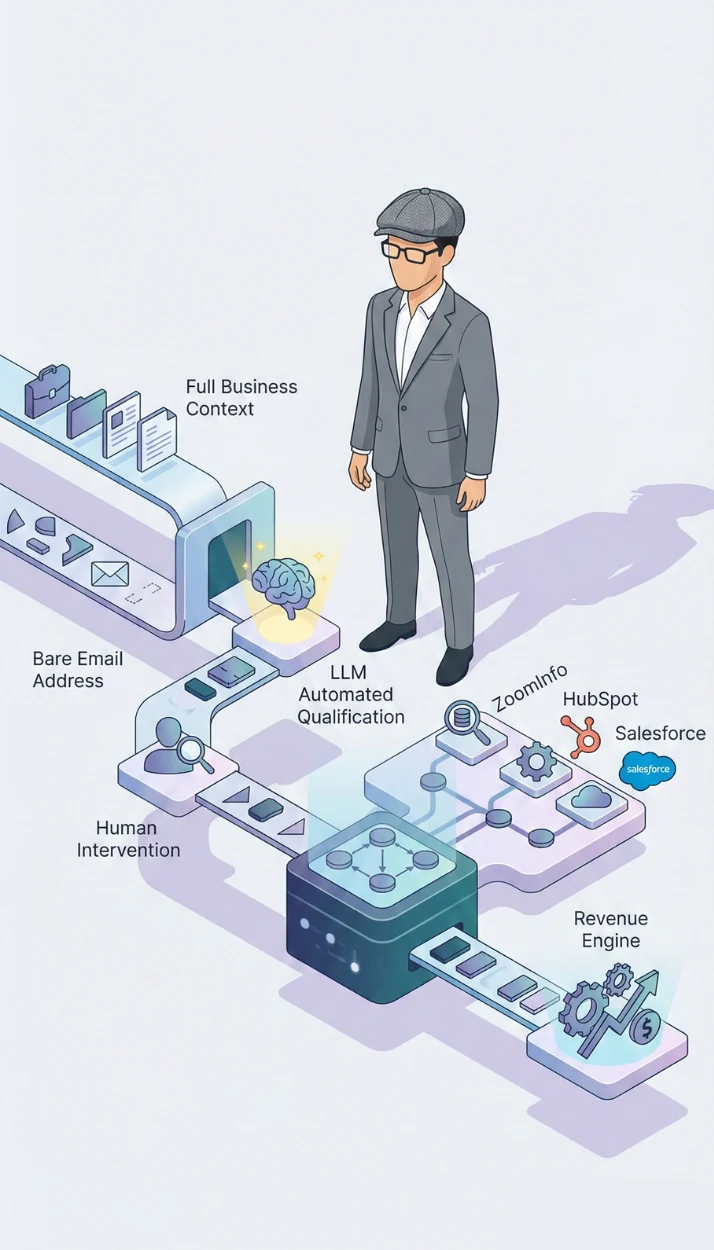
In my case, lead quality varied across regions, categories, and funnels, and the data provided by prospects differed wildly in clarity and completeness. Some leads came in with full business context; others offered only a bare email address and a vague note.

Compliance requirements added additional constraints, and the system needed to differentiate between cases where large language model could handle qualification and cases where humans still needed to intervene.

Enrichment data from B2B database like ZoomInfo and engagement data from HubSpot also needed to be incorporated, and the entire structure had to integrate with our Salesforce and a homegrown CRM without introducing inconsistencies. These constraints meant this could not be a simplistic “automated tool with AI.” It had to be a judgment layer that capable of interpreting nuance and surfacing clean signals into the revenue engine.

Cross-Functional Collaboration

But I'd like to point out, this system not just by AI, but by the needs of every team involved in the revenue process.

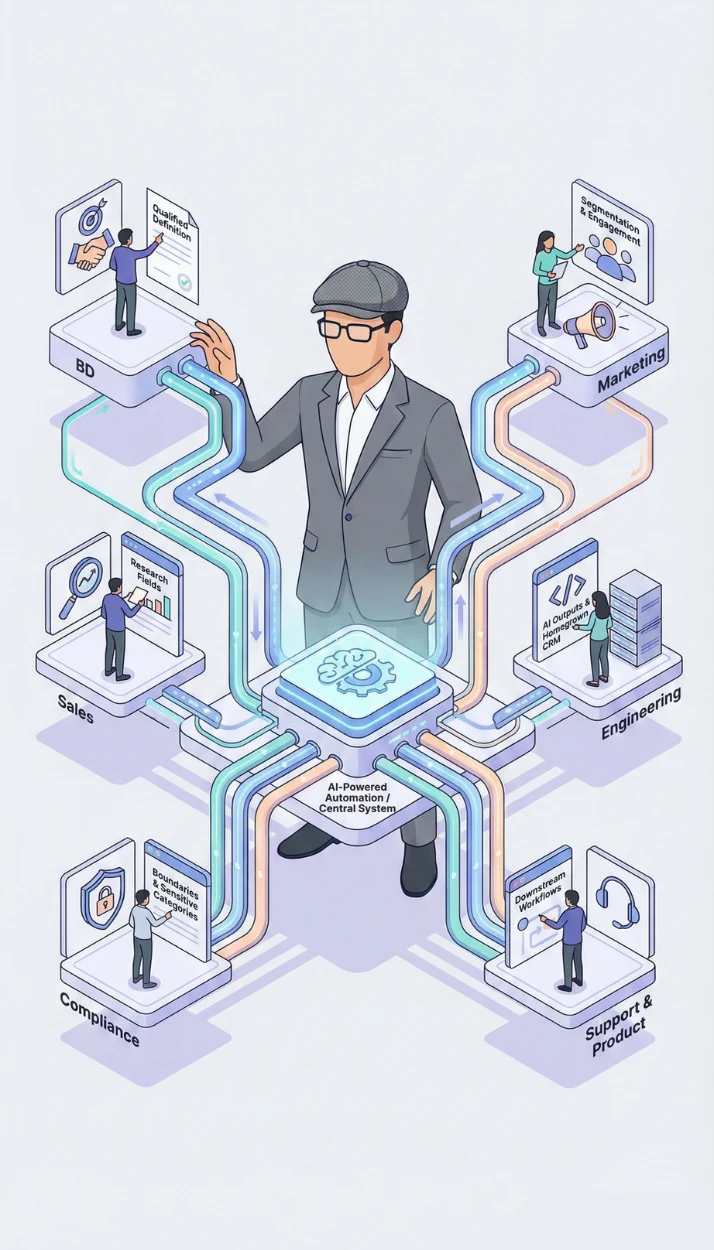
I worked closely with BD to define what “qualified” meant across regions; with sales to identify research fields they repeatedly needed; with marketing to align segmentation, engagement logic, and lifecycle signals; with engineering to integrate AI outputs with homegrown CRM models; with compliance to establish boundaries around sensitive categories; and with support and product teams to ensure downstream workflows remained clean and predictable.

My AI-powered automation succeeded because it was built on a deep understanding of each team’s workflows and the operational realities behind them.

AI as a judgment layer


To address this, I designed an AI vetting engine that serves as the first layer of intelligence in the revenue system.

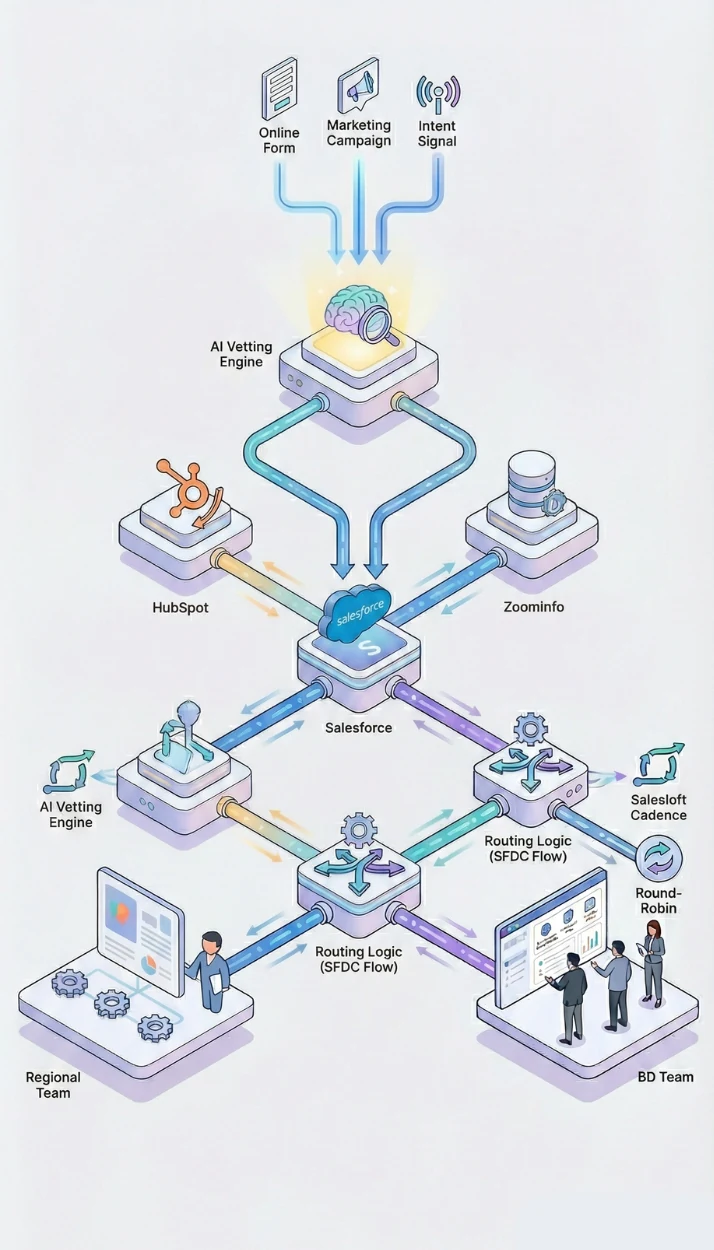
When a lead arrives, no whether through an online form, a marketing campaign, or an intent signal, the AI powered automation can evaluate information that rules-based automation simply cannot. It interprets the business description, distinguishes business domains from personal ones, identifies missing fields, and performs lightweight research to understand the company’s scale, category, and potential relevance.

This interpretation is then combined with marketing engagement patterns from HubSpot and firmographic details from ZoomInfo.
What results is not a score in isolation, but a structured understanding of who the prospect is and how likely they are to be a good fit.


AI transforms unstructured inputs into clear, CRM-ready signals, and this structured output flows directly into Salesforce. Once inside the CRM, routing logic acts (SFDC Flow) immediately: the lead is assigned to the correct regional team, sent through round-robin, and automatically placed into the appropriate Salesloft cadence.

BD teams receive leads with pre-surfaced business insights, contextual notes, and enriched details, giving them a significantly clearer starting point.

Instead of spending the first ten minutes researching, they can begin sales conversations almost immediately. In practice, this AI powered automation replaced a large portion of what BD teams used to do manually and made qualification instant, consistent, and scalable.

Impact

  • The introduction of AI transformed qualification from a manual bottleneck into a reliable, automated decision layer.
  • Manual review dropped almost entirely, with the majority of cases becoming fully automated from the moment the lead arrived.
  • BD teams responded faster and more confidently because they received leads with context and clarity rather than fragments requiring investigation.
  • Routing accuracy reached the level the business always wanted—consistent, predictable, and aligned with regional territories.
  • Pipeline velocity improved because fewer leads sat waiting for someone to interpret them.
  • The company gained a cleaner, sharper view of its funnel, and the revenue engine became more efficient not by adding headcount, but by improving judgment at the very first step.

Why This Matters

Instead of treating qualification as a repetitive manual task, the automation with AI layer turned it into a structured, interpretable, and scalable part of the revenue system. It unified signals from marketing, BD, product, and compliance, and fed them back into CRM workflows that could act instantly.Most importantly, it established an operational foundation upon which future automation, routing, and lifecycle systems could be built.

This wasn’t simply AI assisting with lead research. It was the creation of a judgment engine—one that continues to accelerate qualification, reduce operational drag, and increase the reliability of the entire revenue pipeline.